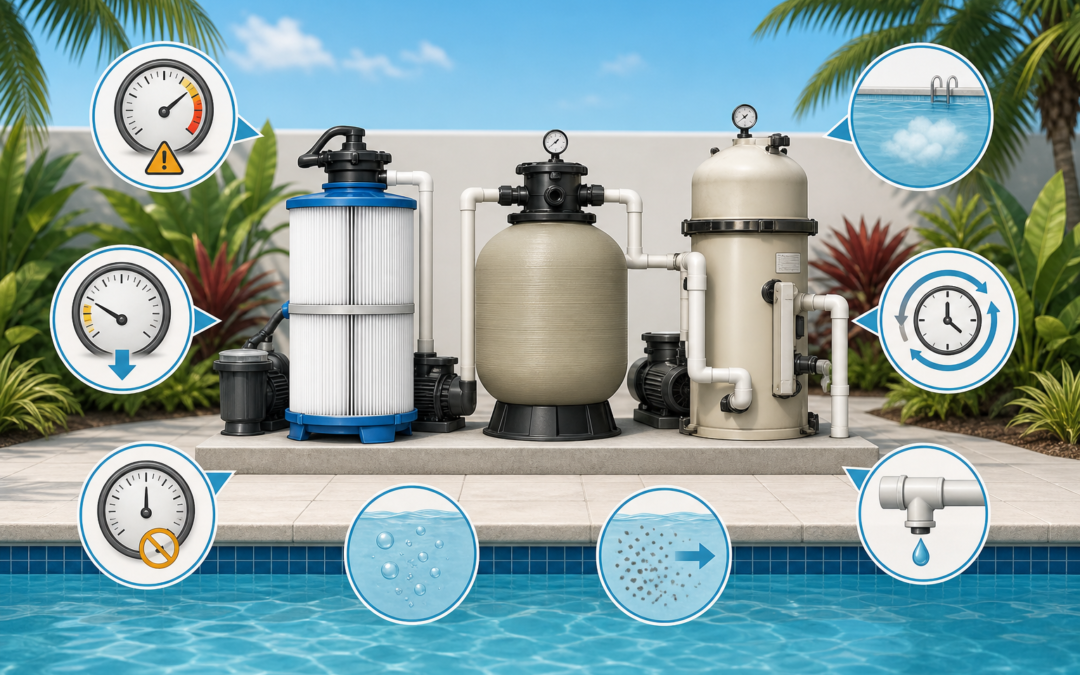
Pool filter problems are not always caused by the filter alone. The pressure reading, water flow, pump operation, valve position, debris load, air in the system, and current water condition all affect what a homeowner sees. That is why one symptom should start an inspection, not a guess.
Cartridge, sand, and diatomaceous-earth filters also have different operating and service requirements. Use the manufacturer’s current instructions for the exact equipment and leave pressurized or unfamiliar work to a qualified service provider.
1. Filter pressure is higher than the normal clean baseline
A pressure gauge is most useful when the current reading is compared with the same system after proper cleaning and normal startup. A rising reading can indicate increasing resistance as the filter captures material, but the correct response depends on filter type and the full circulation condition.
Do not apply one pressure number to every pool. Record the current reading, the known clean baseline, the pump speed, and when the filter was last serviced. A variable-speed system may show different pressure at different programmed speeds.
2. Pressure is unusually low
Low pressure does not automatically mean the filter is clean. Low water level, restricted baskets, air entering the system, a valve position, reduced pump flow, or another circulation problem can limit how much water reaches the filter.
Compare the return flow and visible pump-basket condition with what is normal for the pool. Do not open the filter simply because the gauge is low. The cause may be upstream of the filter or related to the gauge itself.
3. The gauge does not return to zero
A readable, working gauge matters because it is one of the clearest ways to follow system behavior. Pentair’s current Quad D.E. filter guide describes the pressure gauge as a primary operating indicator and says it should return to zero after pressure is relieved and the system is off.
That guidance is specific to the referenced equipment, so owners should review the manual for their exact model. A damaged, unreadable, stuck, or inconsistent gauge deserves attention before its reading is used to make service decisions.
4. Water remains cloudy despite normal cleaning
Cloudy water can involve filtration, but it can also involve circulation, debris, water balance, developing algae, heavy use, or weather. A filter cannot correct every condition by itself, and water treatment cannot compensate indefinitely for poor circulation or a filter that is not operating normally.
The CDC’s Healthy Swimming resources explain why properly maintained water and safe swimming practices matter. If visibility is poor, keep swimmers out while the pool’s water, circulation, and filtration are evaluated together.
5. Filter cycles become much shorter
A filter that reaches its service point much faster than usual may be capturing an unusually heavy load. Recent algae recovery, fine construction dust, storm debris, landscaping runoff, or a large amount of organic material can shorten the interval.
Repeated short cycles can also mean the previous cleaning was incomplete or the filter media or internal components need review. Document how long the cycle used to last, what changed in the pool, and whether the water is improving between services.
6. Water appears around the filter
An active leak may appear at a drain, gauge, air-relief assembly, clamp area, connection, tank, or another nearby component. Water can travel across the equipment pad, so the wettest spot does not always identify the origin.
Never loosen a clamp, lid, valve, or gauge while the system is operating or pressurized. Filter tanks operate under pressure, and manufacturer safety instructions should be taken seriously. Turn equipment off when it can be done safely, keep people away, and arrange an assessment.
7. Air repeatedly collects in the filter or returns
Persistent air can affect circulation and pressure behavior. Owners may notice bubbles at the returns, an unusual sound, or air that reappears after normal startup. The visible symptom does not prove where the air entered.
Report whether the condition changes with pump speed, water level, basket service, or valve operation. Do not repeatedly open a pressurized filter to release air without following the exact equipment instructions and understanding why the condition returns.
8. Debris returns to the pool
Material coming back through the returns may involve filter media, internal components, valve condition, installation, or another circulation issue. The appearance of the debris matters: fine dust, sand-like material, D.E.-like powder, leaves, and air bubbles point to different lines of investigation.
Collect a small sample or take a close photograph if it can be done safely. Avoid assuming that every fine particle is sand from a sand filter or that a replacement filter is automatically required.
Filter type changes the service process
Cartridge filters use removable elements, sand filters use a media bed and valve-controlled service process, and D.E. filters use filtration media and internal grids or cartridges depending on the design. Their cleaning steps, replacement parts, pressure behavior, and safety instructions are not interchangeable.
Use the equipment label to record the manufacturer and model. That prevents advice for one filter type from being applied to another. It also helps the technician confirm parts and current manufacturer documentation before arriving.
What to document for a filter service call
- filter manufacturer, model, and type;
- current pressure and known clean baseline;
- pump speed when the reading was taken;
- date and type of the last filter service;
- water clarity and visible debris;
- return flow and persistent air bubbles;
- where and when water appears on the pad; and
- recent storms, algae recovery, heavy use, or construction dust.
A service history is more useful than a single pressure reading. It helps show whether the issue appeared suddenly, followed another event, or has been worsening across several visits.
When repair or replacement may be discussed
Some pool filter problems involve routine cleaning or an accessible service item. Others involve a damaged gauge, valve, seal, internal component, tank, or equipment that no longer fits the pool’s operating needs. The confirmed condition should guide the recommendation.
A provider should explain what was observed, what can reasonably be serviced, what replacement would change, and whether any related work falls outside its direct scope. Structural work, plumbing alterations, electrical work, and other regulated work should be handled by the appropriate licensed trade when required.
Request an existing-equipment review
Pure Water Pools and Spa services existing pool equipment and performs non-structural equipment work within its stated Martin and St. Lucie County service area. Review the equipment service information or send the filter details for a service conversation.
Request Pool Service View Equipment Services
Pool filter problems FAQ
Is high filter pressure always caused by a dirty filter?
No. A loaded filter is one possibility, but pump speed, valves, circulation, and equipment condition affect the reading. Compare the full system with its normal baseline.
Should a homeowner open a filter that is leaking?
Not while it is operating or pressurized. Follow manufacturer shutdown instructions and arrange service if the safe procedure or cause is uncertain.
Does cloudy water prove the filter is failing?
No. Filtration is one part of water clarity. Circulation, debris, algae, water condition, weather, and filter operation should be reviewed together.